


As the number of home batteries installed through the federal government’s rebate soars above 360,000, and amid complaints about how this favour only the well-off, new data is illustrating the benefits this is bringing to the grid.
The latests Quarterly Energy Dynamics report from the Australian Energy Market Operator has highlighted how – over the summer months – solar and battery households have helped the grid by soaking up excess solar in the middle of the day, and exporting more into the evening peaks.
This has had the happy benefit of addressing too of the market operator’s principle challenges – managing falling levels of grid demand in the middle of the day, and ensuring there is enough supply when it is really needed in the evening peaks. And it has the happy benefit of moderating prices, particularly in the evening.
AEMO provides two interesting examples of this in the country’s two most populous states – NSW and Victoria – and the Victoria one is particularly interesting because it came on the same day as a new record for maximum demand was set in the middle of a heatwave in late January.
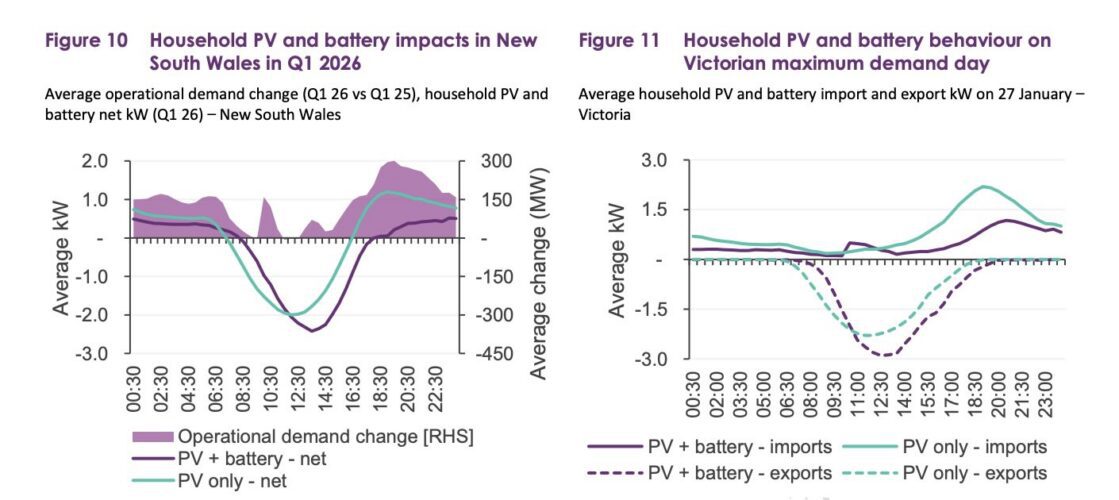
“Across both examples,” AEMO writes, “households with batteries transitioned to exports later in the morning and exhibited higher grid imports, consistent with batteries charging using a combination of rooftop solar generation and grid supply, contributing to higher mid-morning operational demand.
“During the evening peak (1600 hrs to 2100 hrs), households with solar and battery systems continued exporting to the grid for longer and reduced net grid imports relative to solar-only households, reflecting battery discharge to meet household load and support the grid.
“In New South Wales, this reduced average evening-peak net imports by around 0.9 kilowatts (kW) per household relative to solar-only households across the quarter, moderating weather-driven year-on-year demand growth.
“In Victoria, households with batteries reduced average evening peak net imports by 1.4 kW relative to solar-only households on the maximum demand day.”
Energy experts say this is a sign of the program working exactly as designed – as are the grid scale batteries that are also moderating evening prices by displacing higher bidding hydro and peaking gas generators.
See our story: Batteries both big and small have reshaped the grid and forced wholesale prices down, AEMO says
The support in the middle of the day is important as it helps address minimum demand issues, reduces the number of times that wholesale prices fall below zero, and so provides a better market signal for large scale wind and solar.
And it is happening both in Australia’s main grid, and the separate South-West Interconnected System (SWIS) that is the main grid in Western Australia.
“In both grids, batteries are saving up cheap daytime power and pushing it back out at night, displacing more expensive hydro and gas, which is pushing prices down,” writes Hamish McKenzie, the deputy director of the climate and energy program at the Grattan Institute.
“But interestingly, this is also pushing daytime prices up slightly.
“This is the market working exactly as intended – batteries are smoothing out supply and demand and therefore smoothing out prices. Overall, it’s pretty clear that on both coasts, batteries are reshaping the market in real time and the biggest loser is gas.
“It’ll be interesting seeing what happens this winter – how much load can batteries take, how fast do they deplete, and how often is gas forced to step in. We have no idea because there are simply so many more batteries online than last winter.”
Federal climate and energy minister Chris Bowen is also pleased.
“We’ve got the best sun and wind in the world, and we’re using our sovereign renewables to shield our grid from global energy volatility and to bring down your energy bills,” he said in a statement.
“We can also see the impact of Cheaper Home Battery revolution – with more than 350,000 household batteries now displacing gas in the evening with cheap solar, helping the grid for everyone.
“The Coalition’s plan is to stop renewables and household batteries, sweat coal, and leave Australians to pick up the bill of global shocks.
“We know energy bills are still too high – because when coal breaks down, your bill goes up – but this quarter shows steady progress.”
Source: Renew Energy

Write a comment
Các trường bắt buộc được đánh dấu *