

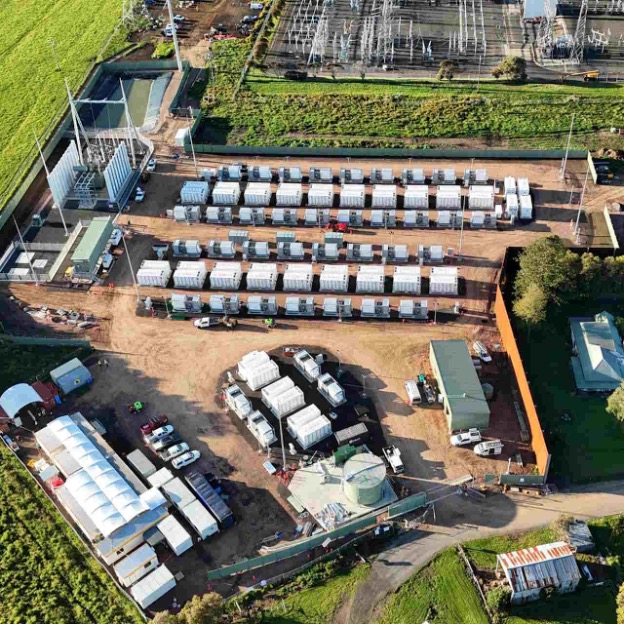

The assessment by the Australian Energy Market Operator, in its latest quarterly report, is good news for the federal Labor government and the states that support its green energy transition, and points to the fundamental importance of battery storage – both at utility scale and in homes and businesses.
The Quarterly Energy Dynamics report notes that 4,445 megawatts (MW) and 11,219 megawatt hours (MWh) of new large-scale batteries has been added to the grid in the last 12 months, more than doubling the installed capacity.
Eight big batteries started commissioning in the first quarter alone, indicating further growth in battery storage, which account for around half of all grid connection inquiries and applications. (See table below).

It’s having a dramatic impact.
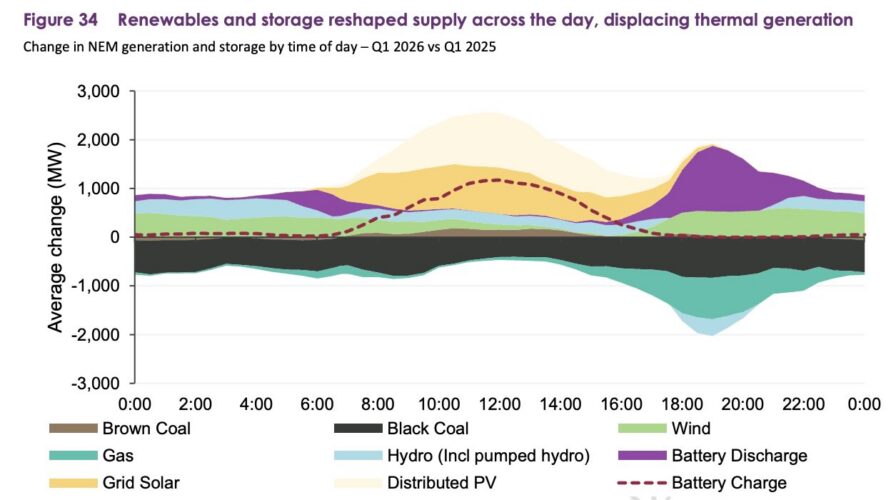
AEMO says the daytime charging rate of big batteries – when they soak up a lot of rooftop solar – has already quadruped, and the amount sent out into the evening peak has also more than tripled to an average of 1,115 MW.
The attraction for big batteries – and some of the emerging new solar-battery hybrid projects – is to be able to sell power at a higher price in the evening. But mostly not as high as gas and hydro, and so they are having a positive impact on prices for consumers.
AEMO says big batteries are now setting wholesale electricity prices in one third of all trading intervals, and are displacing hydro as the most frequent price-setting technology across the main grid, as well as gas.
“The significant increase in large‑scale and household battery capacity is changing how electricity is produced, consumed and priced across the day,” says Violette Mouchaileh, the head of policy and corporate affairs at AEMO.
“Grid-scale batteries are increasingly absorbing excess renewable energy during the day and shifting it into the market during evening peaks, helping moderate prices during high-demand periods.”
For more on how household batteries are helping the grid, please read this article: Solar and battery households help grid by importing more during day and exporting more in evening peaks
The level of renewables was also at record levels, reaching 46.5% of generation, the highest share on record for a first quarter, driven by increased wind and solar output, and despite a 1.2 per cent increase in underlying demand.
There were new records for instant outputs of wind and for solar, and for renewable energy penetration.
Grid-scale solar output reached a new quarterly high of 2,706 MW, up 13 per cent from Q1 2025, while wind output reached a new Q1 high, increasing by 9.3 per cent to average 3,845 MW, driven by increased availability at new and commissioning facilities, primarily in Queensland.
But it was rooftop PV that had the biggest impact, reaching a new Q1 high of 4,090 MW this quarter, and increasing its share to 15.8 per cent of total supply and remaining the single largest renewable contributor. AEMO notes that it is suppressing coal and gas generation during the day as the graph above illustrates.
As for wholesale prices, AEMO reports that they fell 12 per cent from the same quarter last year to an average of $73 a megawatt hour (MWh), and progressively eased through January to March as temperatures fell.
The only state to record an increase in average wholesale prices was South Australia, the country’s most advanced renewables grid with a share of around 75 per cent wind and solar.
Prices in the state jumped 33 per cent to $88/MWh, the highest on the mainland. But this increase was entirely due to one day’s trading – January 26 – due to a major weather event.
The trading on that day – dominated by fossil fuel price setting – accounted for $26/MWh spread across the quarter. Without that impact, average wholesale prices in South Australia would have been lower.
The increase daytime prices as battery charge set prices more frequently, reducing the frequency of negative prices in the northern regions, but that is also a positive for wind and solar farms that would otherwise switch off.
Indeed, economic curtailment of solar farms fell significantly from an average of 8 per cent of availability to 6 per cent, with the situation improving in NSW and Queensland, but getting worse in South Australia (where solar farm curtailment hit 46 per cent of availability) and Victoria.


However, economic curtailment of wind energy increased, mostly in Victoria, a result of prices being forced down due to constraints on the transmission lines flowing north to NSW, and lower flows on Basslink (the link with Tasmania) as a result of changed bidding behaviour since July, 2025.
Network curtailment of grid‑scale solar and wind generation doubled in the quarter to an average of 296 MW, with solar accounting for most of this, largely due to a number of new solar farms fighting for access to the grid in the south of the state and waiting for delayed grid upgrades to be completed.
And there was good news on the emissions front at coal and gas output also fell to new lows. Average coal output fell 4.4 per cent to a new low for the March quarter.
Gas-fired generation recorded its lowest average for any quarter since 1999, down 24% lower from the same period last year – raising questions about the rush of the NSW and Queensland state governments to encourage new gas generation, ostensibly to save a grid that may not need saving.
Total emissions across the NEM fell to a new Q1 low of 26.0 MtCO₂‑e, which AEMO said was a reduction of 1.3 MtCO₂‑e ( or 4.8%) compared with Q1 2025.
But one question mark looms large, and this is about data centres and their impact on the grid.
AEMO reveals, for the first time in the QED, that there are 11 large-scale data centre projects representing 5.4 gigawatts (GW) of maximum demand progressing through the transmission connection process.
Around 60% of capacity is in New South Wales and 40% in Victoria. AEMO says most projects are in the early stages, including seven in the application phase (4.1 GW) and four in proponent implementation (1.3 GW).
Australia’s biggest energy retailer, Origin Energy, has already reported an unexpected increase in electricity sales in the first quarter, which it says reflects growing usage from data centres.
Source: Renew Economy

Write a comment
Các trường bắt buộc được đánh dấu *