


Solar and wind generation have expanded from 2.3% of electricity supply in 2020 to around 5% in 2025, and long-term projections suggest variable renewable energy (VRE) could reach 42–47% of generation by 2045, with some scenarios exceeding 60%. As VRE penetration rises, power systems must manage greater variability, forecast uncertainty, congestion, and balancing requirements.
While higher VRE penetration increases system complexity, global evidence shows that such challenges are manageable. The energy transition remains promising, with a growing portfolio of solutions.
Artificial intelligence (AI) is increasingly applied in power systems globally to address operational challenges. AI models are currently used to improve renewable generation forecasting, enable predictive maintenance, optimise dispatch and unit commitment, support real-time grid control, and operate dynamic line rating. These applications have demonstrated measurable operational improvements in multiple jurisdictions, particularly in systems with growing renewable shares.
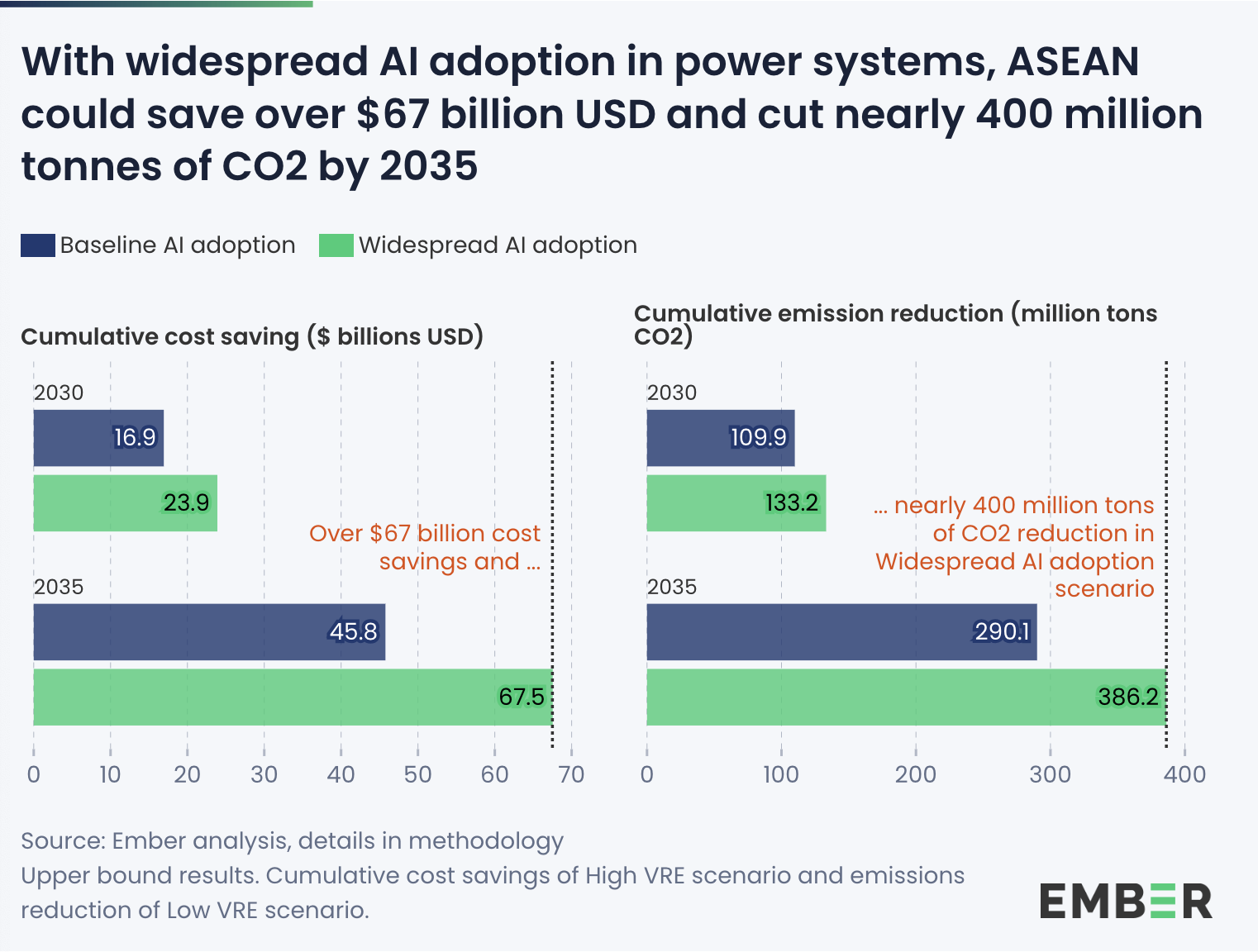
The potential economic and emissions implications of wider AI deployment in ASEAN’s power sector is enormous. Under widespread adoption, AI could deliver up to $67 billion USD in cost savings and reduce nearly 400 million tons of CO2 emissions between 2026 and 2035, on hHigh-VRE deployment pathways, compared to the estimated baseline costs in the absence of AI adoption.
ASEAN shows strong readiness for AI integration. The region’s digital economy is expanding rapidly, data centre capacity is growing, and several large power markets, including Indonesia, Viet Nam, Thailand, Malaysia and the Philippines, perform above the global average in AI readiness indicators. Utilities across the region have initiated pilot applications in forecasting, predictive maintenance and operation optimisation.
However, current deployment remains uneven and largely confined to pilot projects or specific assets. AI is not yet systematically embedded in system-wide planning, market design, or cross-border coordination frameworks. This limits the scale of achievable system-level gains.
At the same time, AI integration introduces identifiable risks. These include data quality limitations, regulatory uncertainty, cybersecurity vulnerabilities, liability ambiguity, and institutional resistance within safety-critical infrastructure. Rapid growth in data centres may also increase electricity demand and strain grids if not aligned with clean power supply. These factors may slow or constrain adoption.

Write a comment
Các trường bắt buộc được đánh dấu *