Wind Resource Management and External Wake Effect Conflicts in Vietnam - Legal Challenges and Technical Solutions
04/06/2026

Agent Black

Wind Resource Management and External Wake Effect Conflicts in Vietnam - Legal Challenges and Technical Solutions

The report "Wind Resource Management and External Wake Effect Conflicts in Vietnam - Legal Challenges and Technical Solutions" by authors from the Institute of Smart Energy Applications Research (iSEAR), the Scientific Council of Vietnam Energy Magazine, and Ho Chi Minh City Electric Power College provides an in-depth analysis of external wake losses as well as the structural safety of wind power projects.


1. Context and current status of spatial conflicts in wind resource exploitation:


Amidst the robust development of renewable energy under the Revised Power Development Plan VIII (PDP8), wind resources in Vietnam are facing an unprecedented legal and technical challenge: spatial exploitation conflicts between adjacent projects. Globally, "wind rights" and the maintenance of a safe distance for the airflow to recover its energy after passing through a rotor are core principles for protecting national resources. However, in Vietnam, the absence of specific technical regulations regarding the minimum distance between turbines owned by different developers is inadvertently creating intense commercial conflicts.


In practice, some late-coming consultants and investors have maximized their survey boundaries by positioning new turbines very close to the borders of existing projects (distances of only 3-5D in the prevailing wind direction). This action aims to fully leverage the existing transportation and grid connection infrastructure invested by the preceding projects, while exploiting areas with the best wind characteristics. However, this high-density layout ignores general technical recommendations to maintain a distance of 7-9D in the prevailing wind direction and 3-5D in the perpendicular direction, leading to aerodynamic shadowing (wake effect), which causes severe performance degradation and directly threatens the mechanical operational safety of currently generating power plants.


Quản lý tài nguyên gió, xung đột hiệu ứng tổn thất gió tại Việt Nam - Thách thức pháp lý và giải pháp kỹ thuật

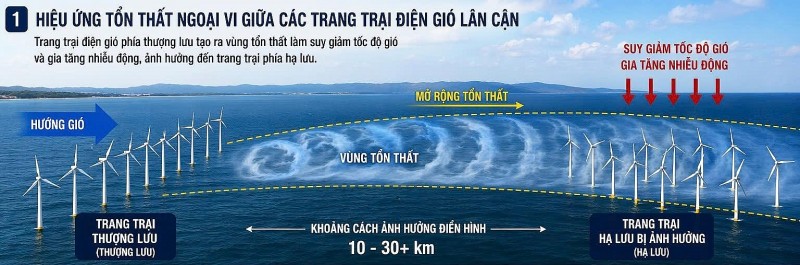
Figure 1: Illustration of external wake effects between wind farms.


Core Technical Concept: External Wake Effect: When airflow passes through a wind farm, the wind speed decreases, and turbulence increases significantly. The distance for the airflow to fully recover to its natural free-stream state ranges from 10 km to over 30 km (depending on atmospheric stability). Therefore, the wake effect between adjacent project clusters causes not only commercial energy yield losses but also adverse fatigue loads on downstream equipment.


2. Evaluation of technical and commercial consequences from an expert perspective:


To evaluate objectively and scientifically, the consequences of external wake effect conflicts must be broken down into two distinct impacts:


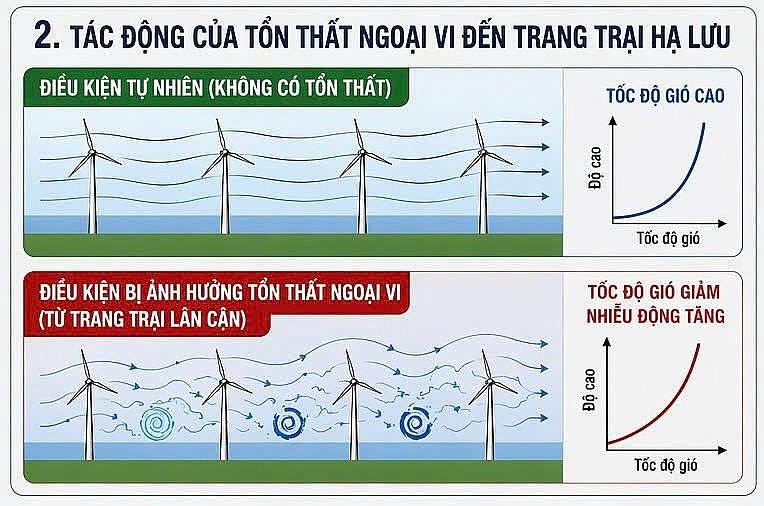
Economic Energy Loss: The presence of large-capacity turbines upstream will reduce the wind speed flowing into the downstream project. Although the reduction in Annual Energy Production (AEP) due to neighboring farms typically ranges from 1% to 5% under normal conditions, this figure can reach extreme levels of 10% to 15% at certain times when monsoons blow directly from the upstream cluster to the downstream cluster at specific turbine locations. This directly diminishes cash flows and local budget revenues.


Quản lý tài nguyên gió, xung đột hiệu ứng tổn thất gió tại Việt Nam - Thách thức pháp lý và giải pháp kỹ thuật

Figure 2: Impacts of external wake losses.


Increased Fatigue Loads and Mechanical Risks: This is a dangerous consequence but is often underestimated during preliminary planning stages. Strong turbulent wakes from excessively close distances (3-5D) will continuously impact the rotor blades, drivetrain, and towers of existing turbines. The increase in effective turbulence intensity beyond the initial design limits, over an extended period, will accelerate material fatigue, increase operation and maintenance (O&M) costs, reduce the economic operational lifespan, and increase unscheduled downtimes.
 

Quản lý tài nguyên gió, xung đột hiệu ứng tổn thất gió tại Việt Nam - Thách thức pháp lý và giải pháp kỹ thuật

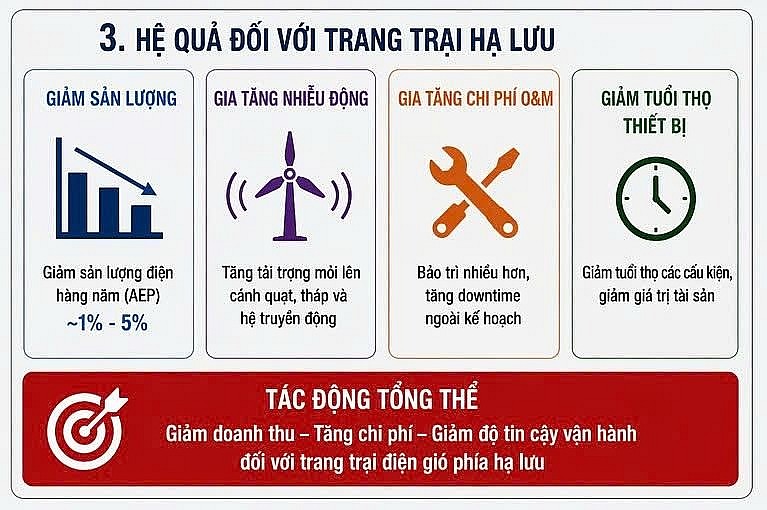
Figure 3: Consequences for downstream wind farms.


Consequences for downstream wind farms include:


  • Degradation of economic lifespan and asset value: The economic operational lifecycle is shortened, reducing long-term asset value.


  • Impact on bankability and financial indicators: DSCR (Debt Service Coverage Ratio) and IRR (Internal Rate of Return) decline due to a combination of reduced energy yield and increased costs.


  • Increased insurance costs: Insurance organizations assess higher risks, thereby increasing premiums or applying exclusion clauses.


  • Increased O&M costs and service contracts: O&M contractors may adjust fees or contract terms upon identifying adverse operating conditions.


  • Increased spare parts and logistics costs: The need for spare parts reserves and the cost of mobilizing equipment and service vessels increase, especially in Vietnam's conditions.


  • Decreased availability and energy yield loss: Increased downtime frequency reduces commercial electricity generation, directly affecting project revenue.


  • Increased corrective O&M costs: Higher breakdown rates entail unscheduled repair costs, particularly for major failures such as the gearbox, main bearing, or blade cracks.


  • Increased Failure Rate (↑): When turbulence exceeds the design class, the fatigue life of main components like blades, towers, and gearboxes is shortened, leading to a significant increase in premature failure rates.


3. Legal arguments and technical standards applied in Vietnam:


Although the national technical regulation system has not yet specified a mandatory distance in meters or rotor diameters (D) between different wind farms, predecessor investors have solid legal and technical grounds to protect their legitimate rights based on current legal normative documents:


  • Circular No. 02/2019/TT-BCT (Ministry of Industry and Trade): Article 10, Clause 2, Point (d) clearly stipulates: The preliminary design dossier must conduct an "assessment of mutual impacts among wind turbines within the project and with adjacent projects.". Therefore, any technical report of a new project that omits or dishonestly calculates the impacts on existing farms violates the project formulation procedure.


  • Decree No. 62/2025/ND-CP (Government): Article 3 regulations on the responsibility to protect power facilities: All organizations and individuals, when constructing new facilities, have the responsibility not to affect the normal operation, lifespan, and functionality of existing power facilities. The negative impact from fatigue loads caused by a subsequent project on a preceding project is a direct violation of this clause.


  • TCVN 10687-1:2025 (Equivalent to IEC 61400-1): The national standard for the design of wind power generation systems mandates a Site Suitability Assessment. A new project must prove that the Effective Turbulence Intensity (Ieff) overlapping the turbines of the existing project does not exceed the Design Turbulence Class of the machine model currently operated by the existing project. If exceeded, the new turbine location completely violates safety technical standards.


4. Recommended action solutions to protect the investment environment:


To ensure a fair, civilized investment environment and the sustainable development of the renewable energy industry in Vietnam, regulatory agencies and investors need to coordinate and implement the following groups of solutions:


  • First: Legalize minimum distance standards: The Ministry of Industry and Trade should soon issue circulars and national technical regulations specifying a minimum distance figure (e.g., applying international practices of 7D-9D for the prevailing wind direction) between turbines of independent projects. Consider this a prerequisite in the basic design appraisal stage.


  • Second: Apply an Independent Peer Review mechanism: Require subsequent project investors to provide an external wake effect and fatigue load impact assessment report, conducted or independently reviewed by reputable international technical organizations (e.g., DNV, UL Solutions). Simulation results must prove no impact exceeding material safety thresholds and commercial energy yields of adjacent power plants.


  • Third: Encourage a Non-interference Agreement mechanism: Encourage enterprises to apply international commercial practices, proactively negotiating and signing buffer zone agreements, or benefit-sharing and financial compensation (if the spatial optimization layout of the subsequent project reduces the actual energy production of the preceding project).


  • Fourth: Affirm and protect property rights: The legal system needs to clarify that the right to exploit wind energy is attached to the offshore/onshore boundaries that have been legally licensed for operation previously. Any infringement causing quantifiable economic damages must be resolved transparently in accordance with the provisions of the Civil Code and the Electricity Law.


Authors:

NGUYEN NGOC TU - INSTIRUDE OF SMART ENERGY APPLICATIONS RESEARCH (iSEAR)

NGUYEN HUU KHOA - SCIENTIFIC COUNCIL OF VIETNAM ENERGY MAGAZINE; HO CHI MINH CITY ELECTRIC POWER COLLEGE


Source: Vietnamenergy.vn
Write a comment

Các trường bắt buộc được đánh dấu *