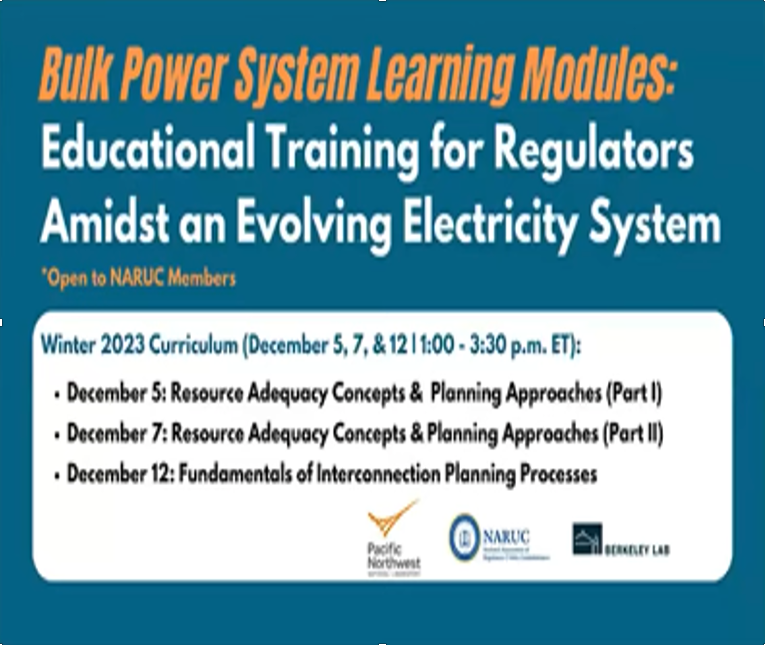
Overview This session is a bulk power systems learning module hosted by the NARUC Center for Partnerships and Innovation in collaboration with the Pacific Northwest National Laboratory (PNNL). The training explores evolving resource adequacy (RA) concepts, new planning methodologies, and regional market updates necessary to maintain grid reliability amidst the ongoing transition to clean energy.
Key Findings & Highlights
The Shift in Planning Metrics: Experts Dr. Marcelo Elizondo and Dr. Todd Levin emphasized that traditional metrics like the Planning Reserve Margin (PRM) are becoming inadequate for grids with high penetrations of weather-dependent renewables. To accurately assess reliability, regulators must adopt more advanced and complex metrics—such as Effective Load Carrying Capacity (ELCC), Loss of Load Expectation (LOLE), and Expected Unserved Energy (EUE)—along with detailed production cost modeling.
Impact of Renewable Integration: The continuous addition of wind and solar generation is shifting the critical risk periods from the traditional gross peak demand hour to the "net peak" load hour. The marginal RA contribution of renewables naturally diminishes as their penetration increases on the grid, underscoring the critical need for energy storage to mitigate unserved energy during these shifting peak hours.
MISO's Strategic Adaptation: Bibi Lee outlined MISO's proactive shift from an annual to a distinct seasonal RA construct to better manage the increasing risks of extreme weather and changing generation profiles. This is supported by macro-to-micro planning processes, including the Regional Resource Assessment and the OMS-MISO survey, which help shrink the size of uncertainty moving from planning to operations.
Western Market Reforms: Nick Pappas discussed the emerging Western Resource Adequacy Program (WRAP), which aims to formalize coordination among western utilities. He also highlighted California’s transition from ELCC to a "Slice-of-Day" framework, designed to give planners a better tool to address the widening 24-hour net-peak periods driven by solar, wind, and battery storage dynamics.
Conclusion Achieving a reliable, fully decarbonized grid is technically feasible with today's technologies, but it fundamentally requires political will, robust inter-regional transmission coordination, and the adoption of highly sophisticated planning tools by both utilities and regulators to manage the emerging complexities of the power system.



Write a comment
Các trường bắt buộc được đánh dấu *