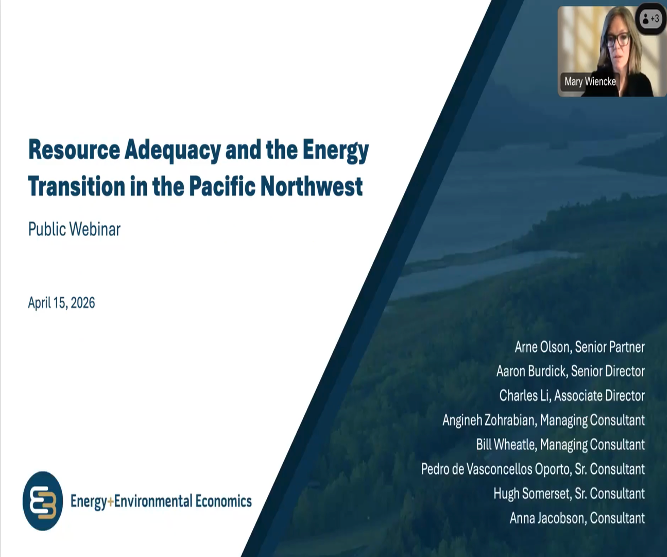
Resource Adequacy and the Energy Transition in the Pacific Northwest
Executive Summary
Overview This presentation by E3 details the Phase 2 findings of the Northwest Utilities Resource Adequacy Study, sponsored by the Public Generating Pool (PGP) and regional partners. Building upon the near-term reliability risks identified in Phase 1, this study explores long-term resource needs and evaluates strategies to achieve deep decarbonization (up to 100% greenhouse gas reductions) by 2045 while maintaining system reliability and affordability.
Key Findings
A Massive and Growing Resource Gap: Accelerated load growth—driven by building/vehicle electrification, organic economic growth, and data centers—combined with the retirement of legacy coal plants, will create a capacity shortfall of 9 gigawatts (GW) by 2030, which expands to 14–18 GW by 2035. Currently, the region is not on track to fill this near-term gap, facing significant development and institutional barriers.
Deep Decarbonization is Achievable and Affordable: The region can successfully meet aggressive clean energy policies (e.g., a 96% GHG reduction) while maintaining reliability. The least-cost balanced portfolio involves a massive buildout of energy efficiency, wind, solar, geothermal, battery storage, and natural gas. The incremental cost of reaching a 96% reduction is relatively modest compared to a no-policy scenario, though overall retail rates will inevitably rise because the marginal cost of new generation is higher than the embedded cost of the existing legacy hydro fleet.
The Critical Role of Natural Gas Peaking: New natural gas capacity is an essential component of a reliable and affordable transition. These plants will operate at very low capacity factors (under 5% by 2045) primarily during multi-day winter cold snaps and low-hydro events. Disallowing new gas would force the region to massively overbuild renewables and short-duration batteries (35–70+ GW of batteries), raising rates by an additional 3 to 6 cents/kWh. Furthermore, E3's analysis shows the risk of these new gas assets becoming "stranded" in the long run is extremely narrow and highly implausible.
The Necessity of Emerging Technologies for 100% Clean Energy: Reaching a 100% absolute zero GHG target using only today's mature technologies would be cost-prohibitive, potentially tripling current electricity rates due to the sheer volume of overbuilding required (over 600 GW of capacity). Emerging clean firm technologies—such as nuclear small modular reactors (SMRs), clean fuels (hydrogen), and carbon capture and storage (CCS)—are vital to affordably bridge the final gap to 100% and can significantly reduce the massive physical footprint needed for wind and solar.
Sub-regional Transmission Constraints: While the greater Northwest may be reliable as a whole, local delivery bottlenecks are emerging. Specifically, the "West of Cascades" region (the I-5 corridor in Washington and Oregon) will face severe constraints by 2035. Upgrades to inter-regional transmission and local capacity are urgently needed to serve the winter peaking demands driven by heat pumps and electrification.
Conclusions & Next Steps Achieving this energy transition will require the region to build new generation and transmission at a rate of 4 to 5 times the historical average. Success hinges on overcoming major institutional barriers in permitting, supply chains, and market coordination, alongside developing a cohesive strategy for both bulk electricity and natural gas delivery infrastructure.



Write a comment
Các trường bắt buộc được đánh dấu *