


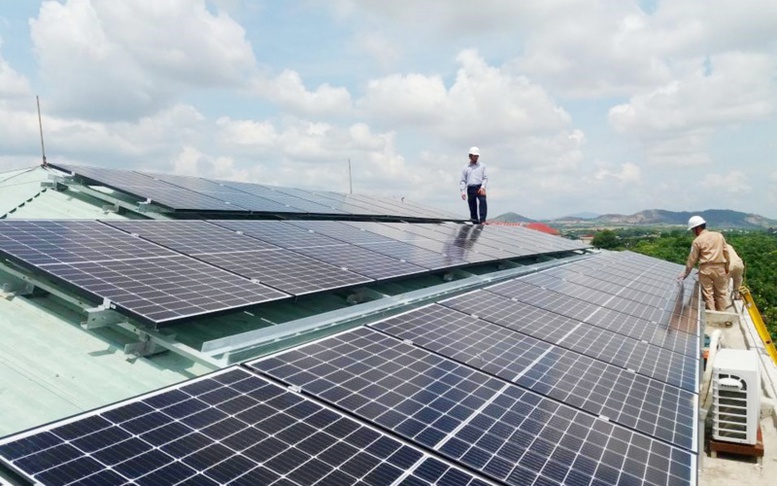
Inhabitants installing rooftop solar system
Alongside rooftop solar panels, many households are opting for integrated lithium battery storage systems. This setup aims to maximize solar energy usage during the day while storing surplus power for nighttime needs or as a backup during outages, ensuring that critical household appliances continue to operate stably.
According to calculations by Mr. Nguyen Huu Khoa (Ho Chi Minh City Electric Power College, member of the Vietnam Energy Scientific Council), based on the Ministry of Industry and Trade’s retail electricity tariff, a household consuming approximately 700 kWh/month will incur costs of over 2.1 million VND. Those consuming about 900 kWh/month will face bills around 3 million VND.
|
Household Electricity Tariff Table (Ministry of Industry and Trade) |
||||
|
Level |
Usage (kWh) |
Unit price/kWh |
Consumed (kWh) |
Amount (VNĐ) |
|
1 |
0 - 50 |
1.984 |
50 |
99.200 |
|
2 |
51 - 100 |
2.050 |
50 |
102.500 |
|
3 |
101 -200 |
2.380 |
100 |
238.000 |
|
4 |
201 -300 |
2.998 |
100 |
299.800 |
|
5 |
301 -400 |
3.350 |
100 |
335.000 |
|
6 |
Over 401 |
3.460 |
300 |
1.038.000 |
|
700 |
2.112.500 |
|||
This spending level is considered ideal for justifying a rooftop solar investment. However, homeowners must still determine the correct system capacity and storage size to match their specific needs.
Using the PVout coefficient (the characteristic sunlight hours of a location to generate 1 kWh per 1 kWp installed), Mr. Khoa proposed three consumption scenarios to calculate payback periods across 34 provinces and cities.
The formula accounts for PV panel technical specifications and Battery Energy Storage Systems (BESS) with 100% charging and 85% discharge efficiency. It also includes factors for total power loss and a 10% load growth buffer.
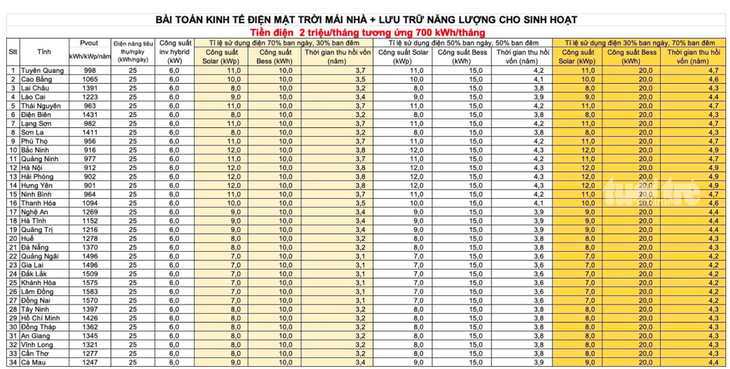
Calculation table for optimal rooftop solar installation based on consumption needs and payback period
Regional Differences: Due to lower solar radiation levels, Northern provinces (excluding Dien Bien and Lai Chau) require higher PV capacity to achieve equivalent energy output compared to the South (using a 6 kW hybrid inverter that can handle a maximum PV input of 12 kWp).
Scenario 1: Daytime Dominant (70% day / 30% night): This scenario offers the lowest investment cost and the fastest payback because energy is used directly during the day.
Northern Vietnam: Payback within 4 years (e.g., Hanoi: 12 kWp PV + 10 kWh storage = 3.8 years).
Southern Vietnam: Payback in just over 3 years (e.g., HCMC: 8 kWp PV + 10 kWh storage = 3.2 years).
Scenario 2: Balanced Usage (50% day / 50% night): While PV capacity remains the same, storage requirements increase (from 10 kWh to 15 kWh), raising investment costs. This extends the payback period by 5–6 months compared to Scenario 1.
Scenario 3: Nighttime Dominant (30% day / 70% night): This requires the highest storage capacity (approx. 20 kWh). Total investment is 13% higher than Scenario 2 and nearly 30% higher than Scenario 1.
Payback: Nearly 5 years in the North and 4 years in the South.
Market surveys show varying investment costs among reputable suppliers:
Systems without storage: 7 – 9 million VND/kWp.
Systems with storage: 11 – 16 million VND/kWp (depending on battery capacity).
Source: Tuoi Tre News
Mr. Nguyen Huu Khoa, Deputy Director of iSEAR Institute

Write a comment
Các trường bắt buộc được đánh dấu *