

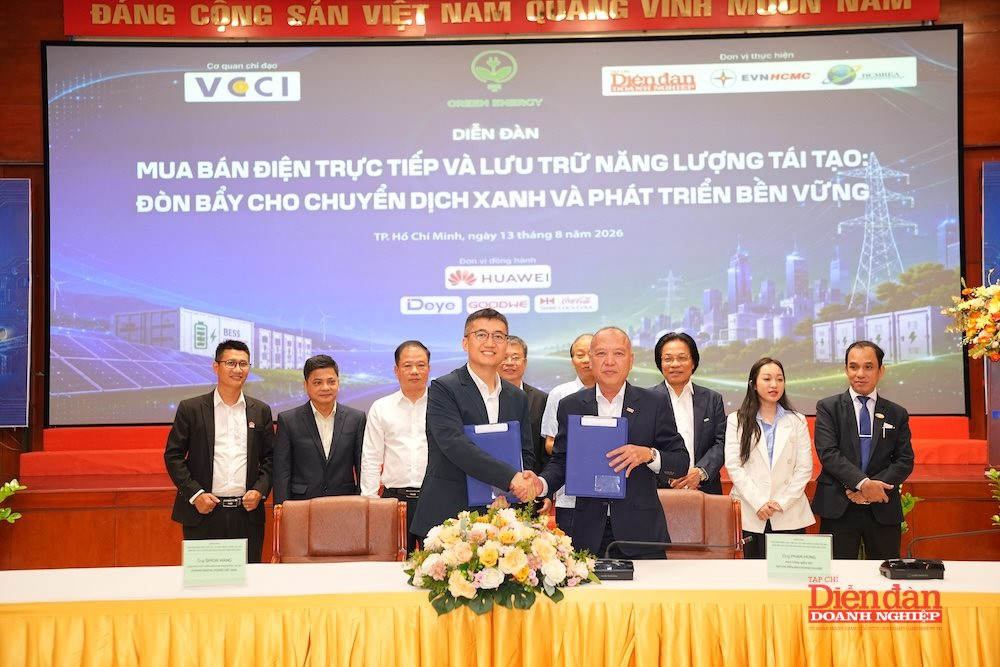
On the afternoon of August 13, under the direction of the Vietnam Chamber of Commerce and Industry (VCCI), the Business Forum Magazine, in coordination with the Institute of Smart Energy Applications Research (iSEAR) and related agencies and units, organized the forum "Direct Power Purchase and Energy Storage Development: A Lever for Green Transition and Sustainable Development."
The boom in rooftop solar power at industrial zones is putting enterprises in the face of a major paradox: power output peaks during the daytime when electricity prices are low or supply is in surplus, while production demand and electricity prices spike in the late afternoon and evening.
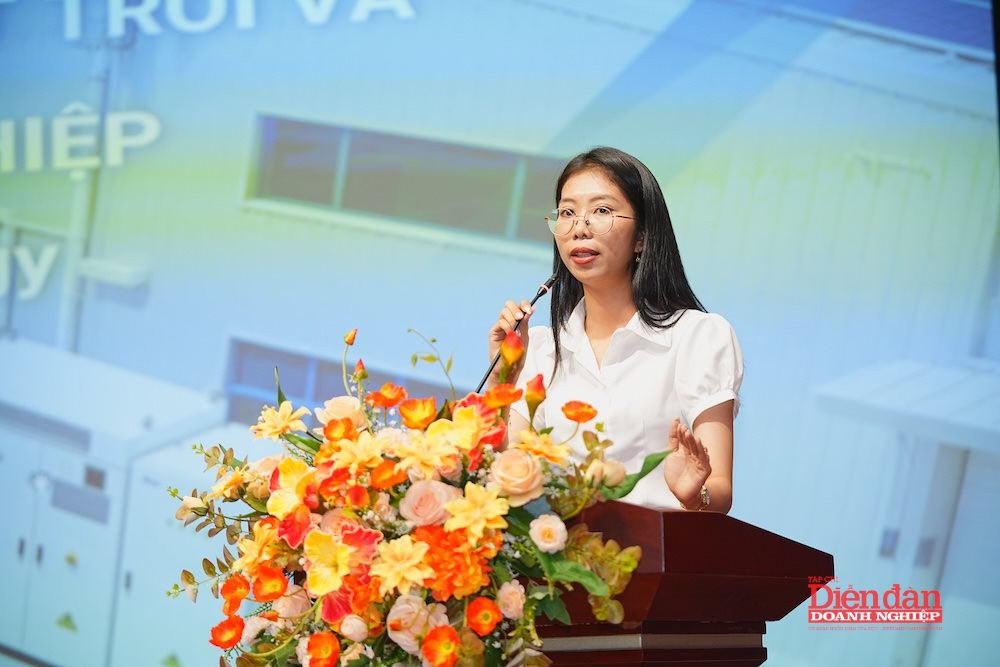
Ms. Nguyen Thi Kim Huong, Head of Training, HCMC Representative Office, Deye Inverter Company, pointed out that Battery Energy Storage Systems (BESS) serve as the "intelligent energy flow coordination platform." BESS resolves this issue definitively by storing surplus daytime generation and discharging it during peak hours.
Regarding BESS system design, Ms. Huong affirmed that there is no single universal storage configuration model suitable for every project. Each plant needs a BESS system designed based on its load profile and actual operational demand.
Speaking about the integrated hardware and AI software ecosystem within the BESS system, Ms. Huong noted that Deye currently controls the entire AI-integrated monitoring chain in-house (Deye Cloud). Its product lines range widely, from residential-grade systems (built to strict fire and explosion prevention safety standards) to industrial-grade systems, including a cabinet line rated from 250 kW to 522 kW that allows unlimited parallel connection.
"In the Vietnamese market, Deye has established an official representative office in Ho Chi Minh City, stepping up technology transfer, workforce training, and a policy of free sample equipment sponsorship for partners that meet output commitments," Ms. Huong added.
Decree 243/2026/ND-CP marks a legal turning point for the Direct Power Purchase Agreement (DPPA) mechanism, clearly delineating the boundary between electricity trading via the national grid and via private transmission lines.
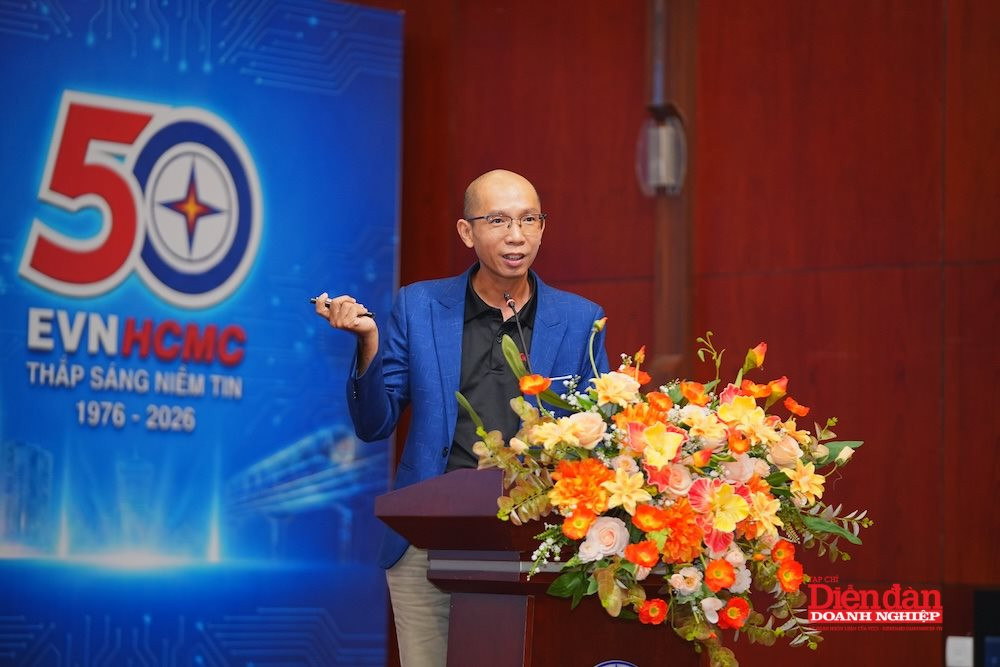
Mr. Cao Xuan Thuong, Head of C&I Business, GoodWe Technology Company, proposed a four-party linkage model comprising: the State (regulatory and system operating authority); the Investor (power generation source developer); the Consuming Plant (large customers with consumption exceeding 20,000 kWh per month); and the Construction Contractor (EPC).
Mr. Thuong argued that this model helps concentrate resources on serving key industrial customer segments. To realize this strategy in Vietnam, GoodWe has: built its first equipment manufacturing plant in Hai Phong (serving both export to the United States and domestic supply); established three major distributors across the North, Central, and South regions; partnered with the HCMC College of Electric Power to build practical technology training facilities; supplied the solution for Vietnam's largest industrial self-generation, self-consumption project, developed by Hoa Phat Group (with a scale of up to 75 MW); and introduced a 261 kW cabinet storage line featuring liquid cooling technology and six-layer protection, built on an open architecture design ready to connect to grid ancillary services such as frequency regulation and voltage stabilization.
From a digital technology solutions perspective, Mr. Nguyen Quang Tu, Head of Solutions, Huawei Digital Power, recommended that investors adopt a synchronized solution (inverter, BESS battery, and central Energy Management System controller) on a single unified technology platform to eliminate the risk of system conflicts.
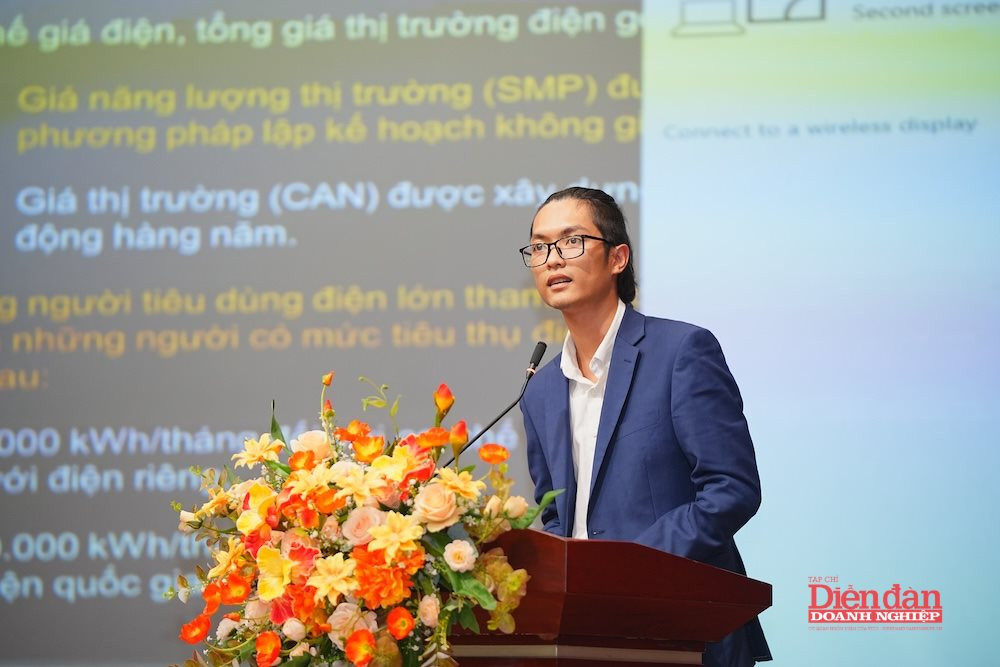
Huawei introduced a chain of breakthrough technologies:
In his closing remarks at the forum, Mr. Hoang Quang Phong, Vice Chairman of the Vietnam Chamber of Commerce and Industry (VCCI), commended the sharp and substantive contributions from experts and enterprises.
VCCI Vice Chairman Hoang Quang Phong confirmed that the organizing committee will compile all proposals and recommendations from experts and enterprises to submit to the competent authorities, with the aim of:
At the event, a Memorandum of Understanding (MOU) was also signed between Huawei Technologies Vietnam Co., Ltd. and Business Forum Magazine.
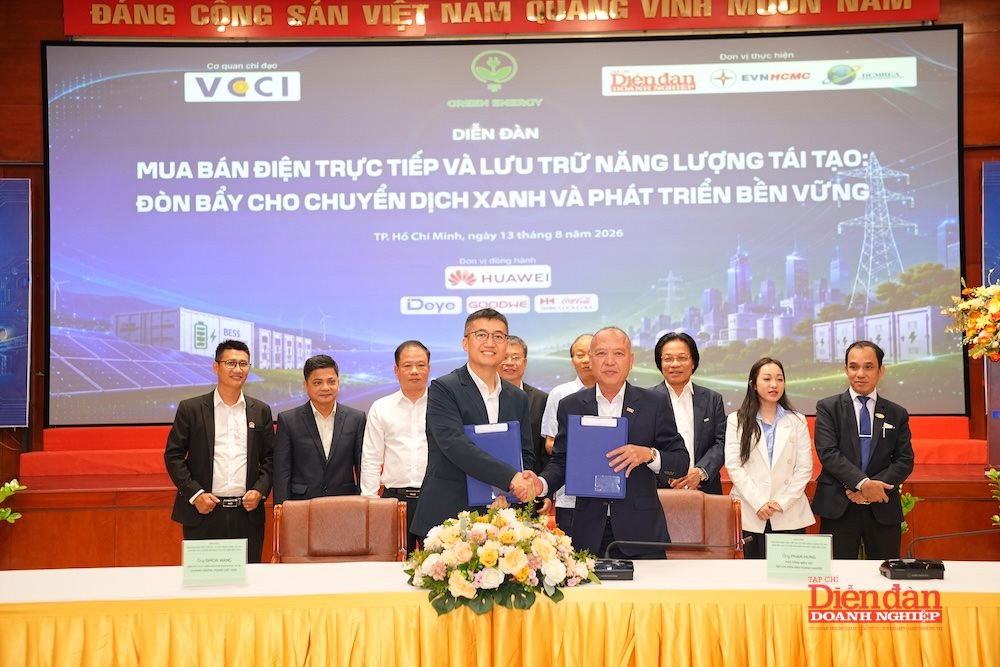
Mr. Simon Wang, Director of Residential, Commercial and Industrial Network Development at Huawei Digital Power Vietnam, and journalist Pham Hung, Deputy Editor in Chief of Business Forum Magazine, signed the Memorandum of Understanding between Huawei Technologies Vietnam Co., Ltd. and Business Forum Magazine.
The cooperation between a leading technology enterprise and a respected economic media outlet is expected to open a new chapter, driving Vietnam's business community toward a methodical, effective, and sustainable green energy transition.
Source: Business Forum Magazine

Write a comment
Các trường bắt buộc được đánh dấu *